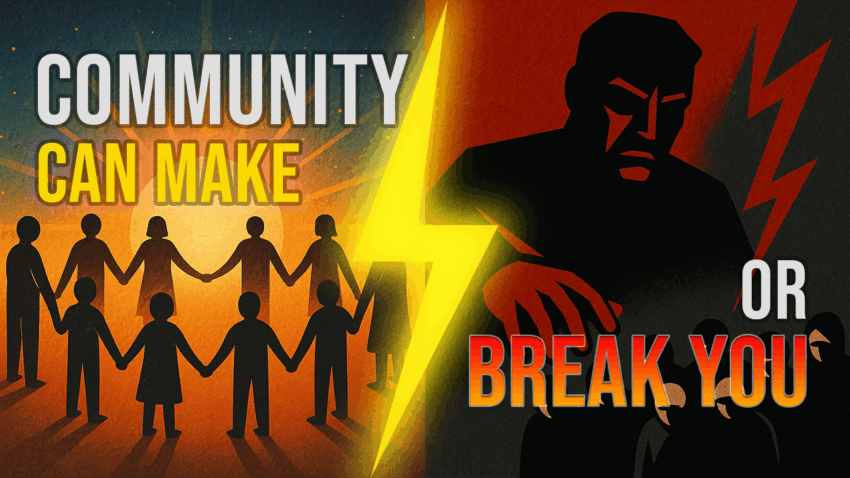
Spiritual community is a double-edged sword. A healthy group can amplify your agency, give you strength when you falter, and create a kind of shared aliveness no one person could hold alone.
But as I talked about in my video this week, community also has a shadow side. The same power that can make you can just as easily break you.
It’s easy to assume intelligence or self-awareness makes us immune to high-control dynamics. In truth, our intelligence can work against us—helping us rationalize or explain away what should concern us. The line between empowerment and control is thinner than most of us realize.
That’s why learning to recognize both red flags and green flags is essential if you want to step into spiritual community with your sovereignty intact.
Green Flags: Signs of a Healthy Community
1. You can say no.
Healthy groups protect aliveness through clear structures and fair processes. Boundaries are respected:
- Belonging isn’t contingent on endless labor.
- You have final say over your time and energy.
- You aren’t made responsible for other people’s feelings.
When these structures are working, everyone leaves more resourced than they would be alone—not drained.
2. Leaders are accountable.
Authority is transparent and boundaried. Roles are clear, and the gap between formal and informal power is small.
- You know who to turn to with problems and how decisions are made.
- Titles don’t inflate egos; roles can be learned and shared.
- Decision-making processes are clear—and actually followed.
3. The purpose makes you more yourself.
Every group has a higher purpose. In healthy community, that purpose strengthens individuality rather than consuming it.
- Service to the group’s mission gives back more than it takes.
- Participation doesn’t erase identity—it enables growth and possibility that wouldn’t exist otherwise.
4. Mystery is held without collapse.
Esoteric or spiritual teachings empower rather than control.
- Critical thinking isn’t suppressed; intensity isn’t exploited.
- The group can hold strong energy—spiritual, magical, even erotic—without spiraling into chaos or clamping down.
- Mystery serves as fuel for empowerment, not a tool of dependency.
Red Flags: Signs of an Unhealthy Community
1. Saying no isn’t safe.
If you can’t opt out without punishment, exile, or guilt trips, your freedom is already compromised. Watch for:
- Burnout and constant complaints about “drama.”
- Groups that reach into your personal life—controlling who you see, what you post, or where you work.
2. Power hides in the shadows.
Authority is vague, denied, or cloaked in phrases like “We all walk this path together.” But wherever people gather, power exists. The question is whether it’s transparent.
- Dysfunctional groups run on backchanneling and undermining.
- Informal power justified by charisma is a recipe for abuse.
- You have a right to know who’s in charge, how decisions are made, and where to take a complaint.
3. The group identity swallows individuality.
When the group’s purpose is unclear or only ambiguously defined, jockeying and betrayal thrive.
- If members aren’t serving a clear purpose, they’re serving egos—their own or the leaders’.
- If belonging means silencing your truth, the group isn’t serving you. It’s feeding on you.
4. Mystery turns into manipulation.
Dysfunctional groups weaponize intensity—emotional, sexual, or spiritual—to override discernment.
- “Mystery” or “multiple meanings” are used to shut down critical thinking.
- Intense experiences are leveraged to pressure conformity, not spark authentic growth.
- Symbolism isn’t a gateway to transcendence but an invitation to lie down in a gilded coffin.
A Personal Note
I speak from experience. All of these red flags were present during my time in OTO. Yet instead of leaving, I stayed for years and even became a leader.
It wasn’t a lack of intelligence or self-awareness. The problem was that red flags appeared alongside neutral or even positive aspects of the group. I didn’t yet know how to tell a red flag from a yellow one. I saw them, but I didn’t recognize them for what they were.
High-control groups are skilled at using your strengths against you. They train you to focus on the particulars instead of the big picture. They don’t explain—they explain away.
It wasn’t until I stepped back, and later spoke out, that the reality became undeniable—for me and for many others.
But you don’t need to repeat my experience. Learning to spot red and green flags early will help you focus on what matters most, avoid groups that drain you, and find the ones that truly bring you alive.
Closing
Community has the power to transform us, but it’s never neutral. It can multiply sovereignty, or it can devour it.
Recognizing red and green flags isn’t about finding the perfect group. It’s about building the muscles of discernment. The more you strengthen that muscle, the faster you’ll know when a community is helping you become more yourself—and when it’s quietly pulling you away from your center.