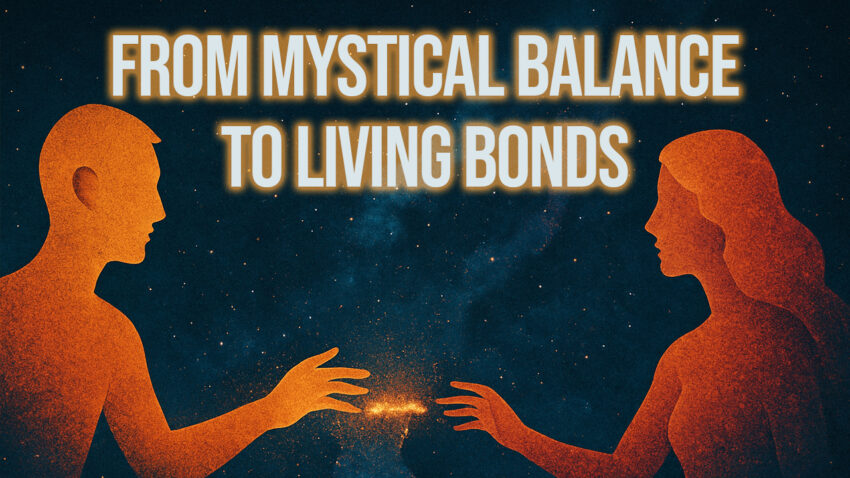
Thelema gives us a powerful metaphysical vision: each person has a true will, a unique trajectory through life, and love is the law that aligns oneself with that trajectory. Union, polarity, and relationship are built right into the system. Nuit and Hadit, the Serpent and the Egg, and the Rosy Cross are not solitary symbols. They’re images of balance, reciprocity, and creative union—embodiments of the Thelemic theory of ultimate reality.
But Thelema gives us very few tools for living that out in real relationships.
The methods of Thelema—ritual, meditation, and magick—send us inward again and again. They help us discover and align with our own will. That’s not wrong. In fact, for people with insecure attachment, it can be a life-saving corrective.
- A-strategies (the avoidant spectrum) often disconnect us from our own longing. Turning inward can reconnect us with needs we’ve muted.
- C-strategies (the preoccupied spectrum) tend to over-monitor the other person. Turning inward can restore self-contact and break cycles of anxiety.
So yes, Thelema’s inward emphasis can be exactly what’s needed.
But it’s incomplete.
Secure attachment isn’t just an abstract “balance.” It’s a trained capacity. It’s the ability to flex between cognition and affect, head and heart, in contact with another person. It’s knowing how to soothe and be soothed, how to reality-test together, how to build a bond that makes both people more rational, more resourced, more self-actualized than they’d be alone.
And that’s where Thelema is largely silent. It gives us metaphors of balance but not the practices for cultivating it. It gives us the why but not the how.
That’s the missing technology of relationship.
If Thelema is going to live beyond heroic individualism, if “love under will” is to be more than a slogan, we need to develop and import practices that actually train us to live securely and flexibly with one another. I’ve tried to show how attachment theory—especially the Dynamic Maturational Model—can plug into this gap. I see it as a practical complement to what Thelema has always proclaimed: that love and will are inseparable, and that relationship is not a distraction from true will but one of its engines of realization.