Wittgenstein once remarked that even if lions could talk, we still wouldn’t understand them. The problem isn’t language, but form of life. What counts as meaningful depends on shared skills, environments, and patterns of salience. A simple question like “Do you have a minute?” makes sense to us because we share those contexts.
Spirituality, too, reflects a form of life. But it can also transform one.
At its propositional level, spirituality deals in beliefs and symbols: “The Sun represents God.” “Each person has a true will.” At its procedural level, it is the set of skills, rituals, and practices that put those beliefs into action. As Wittgenstein might say, propositions only ever make sense in the context of the practices that give them life.
Consider the Thelemic maxim, “Do what thou wilt shall be the whole of the Law.” The phrase only means something in relation to human capacities and failures—to the fact that it is possible to act against one’s will. The practice of “Saying Will” before meals, for example, doesn’t magically align your actions with your purpose. What it does is reshape your salience landscape, training you to foreground the question of will in every situation. Over time, identity and action reorganize around this central axis.
This is the transformative promise of any genuine spiritual path: that it increases agency. That it alters what you can do, what you can understand, and how you fit yourself to reality.
But we know the causal arrow often runs the other way, too. People adapt spiritual symbols to preexisting habits. Christianity can yield Albert Schweitzer’s radical compassion or Creflo Dollar’s prosperity gospel. Thelema can mean a lifelong search for one’s true will or simply “doing whatever you want.”
To see what spirituality is actually doing, we have to look beyond hypocrisy or bad faith and consider its structural function. Systems don’t run on violence and oppression alone. Harm has to be rationalized, aestheticized, and made to feel meaningful.
This is the clearest way to understand OTO. Abstracted from its rhetoric, it is an autocratic hierarchy designed to maintain control from the top down. It is not essentially different from other high-control groups. But its survival depends on rationalizations and subtle manipulations, not just overt aggression.
Here Thelema plays a paradoxical role. The religion of individual freedom becomes the rhetoric that makes control feel natural, even ridiculous to question. Members are trained to treat the suggestion that OTO could be a high-control group as laughable.
OTO bullshits people—not incidentally but systematically. I don’t mean that it lies (although it does that as well). I mean it systematically trains people to divert their attention away from what matters. Instead of meaningful accountability, there are forms and processes. Racism and sexism by leaders are responded to with diversity modules for the lowest-tier members. Surveillance is reframed as “bringing receipts”. Getting a concusion is an “ordeal”.
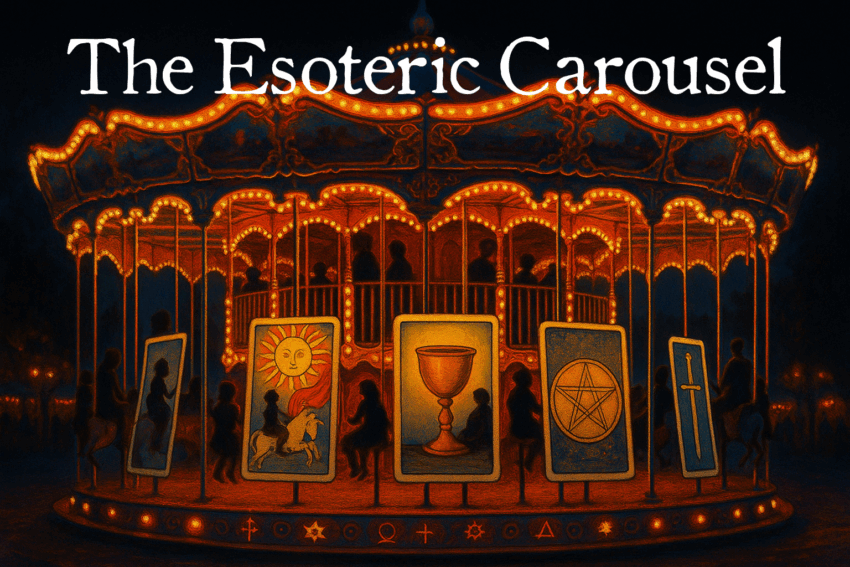
Esotericism is the leading edge of systematic bullshit in OTO. OTO’s highly aestheticized, mythologized environment itself functions as a charismatic leader. Tarot cards, incense, myth, and ritual dazzle the salience machinery. They enchant, they entrance. And the esoteric content delivered in classes or initiations is usually trivial: a string of “facts” about what symbols mean without any corresponding empowerment.
The real lesson, learned tacitly, is how to better fit oneself to the system. To marvel at “multiple meanings” without gaining any new capacity for action. To mythologize dysfunction and violence as “ordeals.” To mistake aesthetic entrancement for transformation.
That doesn’t mean Thelema never transforms people inside OTO. But when it does, the results often push them outside its bounds. Those who are genuinely altered in ways the system can’t use tend to leave or be removed. Those who rise inside learn to call disjointed symbolism “profound,” because a deeper sense of profundity would threaten their position.
The insight here is not that OTO members are insincere, nor that spirituality is always corrupt. It’s that spirituality always does double duty: it expresses a form of life, but it also reshapes one. The question is always: transformed into what? Fitted to what?
Any liberating path trains perception and action toward greater agency. Any authoritarian system will redirect that training back toward its own survival. The aesthetics of spirituality can conceal either process. Which is why the real test of a path is not what its symbols say, but what they allow you to go on to do.